
Is Eczema Contagious? Debunking Myths
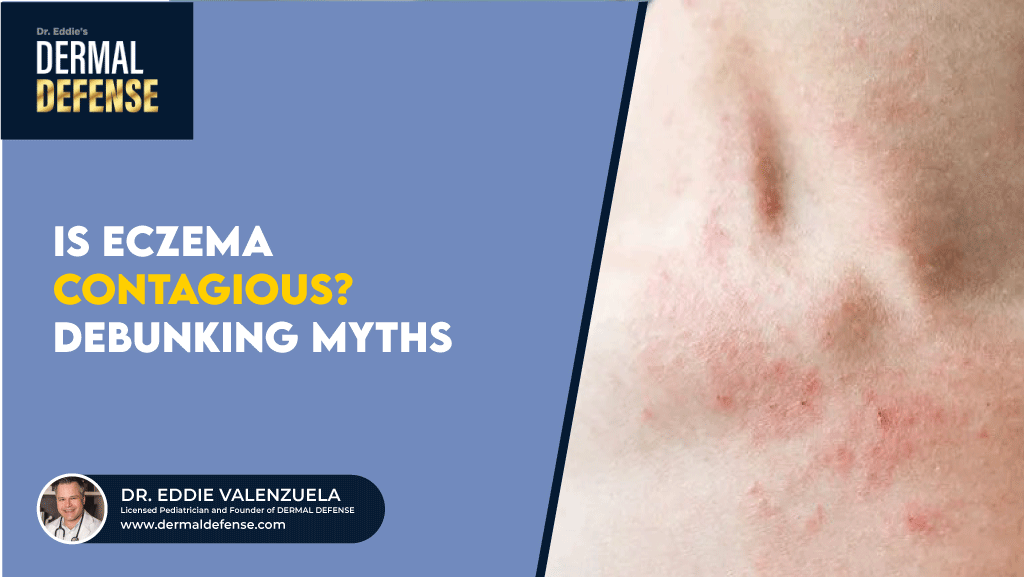
No. Eczema is not contagious and cannot be passed from person to person through touch, intimacy, or shared items.
It is a chronic inflammatory skin condition related to genetics, immune response, and skin barrier function.
Eczema is a common skin condition. According to the National Eczema Association, it affects about 31.6 million people in the USA. Despite being so common, eczema is still surrounded by many misconceptions.
Questions like “Is eczema contagious?” “Will eczema spread to others?” and “Can eczema spread on your body?” may pop up in your mind and cause confusion or concern. That is why we decided to write this blog.
In this article, you will learn what eczema is, can eczema be contagious, and we will debunk some of the most common myths surrounding this condition.
What is Eczema?
Eczema refers to a group of chronic skin conditions that often lead to dry, itchy, red, scaly skin. Some of the most common types of eczema are:
- Atopic dermatitis
- Contact dermatitis
- Nummular eczema
- Stasis dermatitis
- Seborrheic dermatitis
- Dyshidrotic eczema
- Neurodermatitis.
In everyday language, eczema is used to refer to its most common type, “Atopic dermatitis.” It is more common among children under the age of 5. However, anyone can experience it at any time.
In some cases, the symptoms may resolve over time, while for others, they may recur in the form of flare-ups. Some common symptoms of eczema are:
- Dry skin
- Itchy skin
- Redness
- Scaly or flaky skin
- Small bumps that may ooze and crust
- Skin lichenification
- Increased sensitivity
- Inflammation
The symptoms may vary from person to person depending on the severity of the condition. However, there are other skin conditions like psoriasis and rosacea that can look similar to eczema.
So if you are unsure about anything, it is best to consult a dermatologist.
Is Eczema Contagious?
Now the question arises: Is dermatitis contagious? The answer is no, eczema is not contagious. You can not catch eczema from another person, nor will you give it to others. It is not an infectious condition caused by bacteria or viruses; instead, it involves inflammation related to skin barrier dysfunction and immune response.
Eczema, according to the researchers, is believed to be caused by a combination of factors such as
- Genetics
- Impaired skin barrier
- Overactive immune system
- Environmental factors.
Dermatologists classify eczema as a non-infectious inflammatory skin condition.
Myths About Eczema
Now, let’s debunk some of the most common myths about eczema being contagious or spreading.
1. Eczema Can Spread by Touching
If you are wondering, “Is Eczema Contagious by Touching?” the answer is no. You will not contract eczema by touching, hugging, or caring for someone who has eczema. However, if you are taking care of your child with eczema, then make sure to wash your hands before touching them.
Because eczema weakens the skin barrier, the skin is more prone to infection.
2. Is Eczema Contagious Sexually?
Eczema is not contagious. It is not a sexually transmitted infection or disease, so intimate skin-to-skin contact can not transmit it.
3. Weeping Eczema is Contagious
In severe eczema, the rashes may sometimes ooze and crust. Many people think that oozing can spread eczema. However, this is not the truth. The answer to “Is weeping eczema contagious?” is no, it is not.
Even though eczema itself is not passed between people, it makes your skin more vulnerable to developing secondary skin infections, such as eczema herpeticum (a herpes virus infection) or bacterial infections like Staphylococcus aureus.
4. Eczema Spread on Your Body
Can eczema spread on the body? Technically yes. But this does not mean that eczema is infectious. Eczema may seem like it’s spreading to other parts of the body when it becomes worse due to
- Intense itching and inflammation
- Not following a proper eczema skincare routine
- Dry skin
- Exposure to your eczema triggers
Why Do People Think Eczema is Contagious?
If eczema is not contagious, then why do people think that it is? It is because its symptoms look quite similar to those of infectious skin conditions. During an eczema flare-up, it often causes red, inflamed, visible rashes that may seem alarming to others.
Secondly, eczema often causes intense, persistent itching that can be hard to resist. When people see someone scratching red, inflamed rashes, the visible irritation reinforces the false belief that eczema is something others might catch.
Also, there are certain skin conditions, such as ringworm and scabies, that are passed between people and share similar symptoms with eczema, such as itching, red rashes, and lesions. This is why people often confuse them, which fuels the misconception that eczema can spread.
Skin Conditions That Can Be Mistaken for Eczema (and May Be Contagious)
.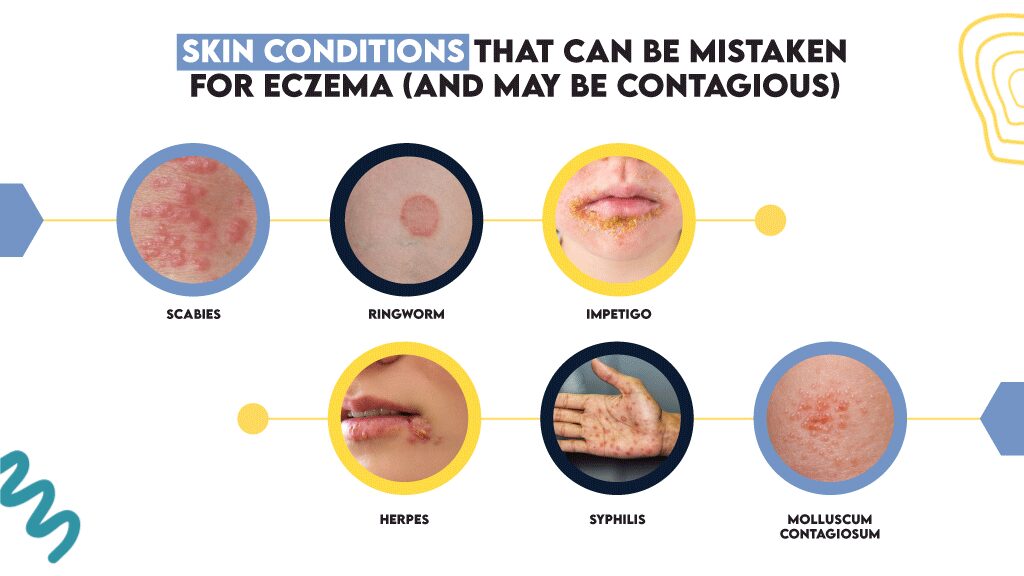
Some of the most common skin conditions that are often confused with eczema and are actually infectious are:
- Scabies
- Ringworm
- Impetigo
- Herpes
- Syphilis
- Molluscum contagiosum
Apart from these, eczema can resemble other skin conditions that are not contagious, such as psoriasis, fungal infection, and rosacea. So if you notice that eczema is not getting better with eczema treatment or is getting worse, then it is best to consult a dermatologist.
As there are chances you may be experiencing any of the above-mentioned skin conditions.
Eczema Treatment
Even though eczema is not contagious, its symptoms can become worse over time and cause more discomfort if proper care and attention are not given to the skin. A few things that you can do to manage eczema and prevent it from becoming worse are:
Cleanse the Skin
When you have eczema, it is essential that you follow a proper skin care routine and stay consistent with it. The first step in your routine should be to keep your skin clean. While any face and body wash available can help cleanse your skin.
The truth is, the harsh chemicals in those skin products can actually make your condition worse. This is why you must choose an eczema cleanser that is free from skin-irritating chemicals and is specially formulated for sensitive skin, such as the Dermal Defense Eczema Body Wash.
- Use it at least once daily to take a bath and cleanse your skin.
- You can also use it as a face wash twice daily to cleanse your face once in the morning and once at night.
Moisturizing
The second and most crucial step in managing eczema is moisturizing the skin. Excessively dry skin is a common symptom of eczema. This is due to the weak skin barrier that is unable to retain moisture in the skin.
However, leaving the skin dry can actually make your condition worse, so moisturize your skin with the help of an eczema cream as much as possible.
- Moisturize your skin at least twice daily.
- Make sure to moisturize after taking a bath while the skin is still slightly damp.
- Place a hypoallergenic eczema moisturizer close to your sink so you can moisturize your hands every time you wash them and prevent your hand eczema from getting worse.
Just like the cleanser, it is essential that you make sure the body moisturizer you are using is also free from any harsh chemicals. If you are searching for an eczema-friendly moisturizer, then try Dermal Defense Eczema Cream.
Avoiding the Triggers
There are various environmental triggers, such as harsh chemicals in soap, poison ivy, hard water, and perfumes, that can actually make your eczema worse or trigger a flare-up. So, to prevent your condition from getting worse, you must avoid the triggers as much as possible.
Eczema Medications
If your eczema is not getting better or you are experiencing severe eczema even after taking proper care of your skin and avoiding the triggers, then you can consult a doctor or dermatologist.
If your eczema is not improving with proper skincare and trigger avoidance, a doctor or dermatologist may recommend medications such as:
- Topical corticosteroids
- Topical calcineurin inhibitors
- Topical JAK inhibitors (such as ruxolitinib cream)
- Injectable biologics
- Oral JAK inhibitors
- Antihistamines
- Other systemic immunosuppressants
These medications should only be used under the guidance of a healthcare professional, as they may have potential side effects.
Tips to Prevent Eczema Flare-ups
Even though you can not entirely prevent an eczema flare-up, there are a few things that may help you in preventing it to some extent, such as:
- Avoid using hot water to wash your skin.
- Keep your skin moisturized as much as possible.
- Take a short lukewarm bath or shower.
- Pat dry your skin after washing instead of rubbing it.
- Wear loose-fitting clothes made with breathable fabric.
- Keep the air inside your home moist with the help of a humidifier.
These may sound like little things, but they can have a great impact on your skin’s health.
Conclusion
Eczema is not contagious, not spreadable, and not something you can catch from others. People often assume that eczema is contagious because
- It resembles other infectious skin conditions like ringworm.
- Causes intense itching and red rashes that are common symptoms of contagious infections.
- It can lead to secondary infections that are contagious.
- It starts appearing on other parts of the body when it becomes worse.
No matter what your reason is, one thing is for sure that eczema is not transmissible. However, managing it is essential to prevent your condition from getting worse. Mild cases of eczema can be managed at home with an eczema skincare routine.
You can use the Dermal Defense eczema skincare bundle that includes an eczema cleanser and an eczema moisturizing cream to help simplify your routine.
FAQs
- Can eczema be spread from person to person?
No, eczema cannot be spread from person to person. Eczema is not contagious and cannot be transmitted through touching, hugging, sharing personal items, or close physical contact.
- Is eczema contagious to babies?
No, eczema is not contagious to babies. Babies cannot catch eczema from parents or siblings. However, eczema can run in families, so if the parents have eczema or have a family history of atopic dermatitis, hay fever, asthma, or allergies, the baby is more prone to developing eczema.
- What triggers eczema to spread on your body?
Eczema may appear to spread on your body due to flare-up triggers, not because it is contagious. Common triggers include:
- Scratching and the itch–scratch cycle
- Dry skin
- Harsh soaps or cleansers
- Allergens such as dust mites or pet dander
- Stress or hormonal changes
- Weather changes, especially cold or dry air
- What is the best treatment for eczema?
The best eczema management focuses on strengthening the skin’s natural barrier and reducing inflammation. This can be done by:
- Keeping the skin clean with a fragrance-free eczema cleanser.
- Keep your skin moisturized with a hypoallergenic eczema moisturizer.
- Avoid triggers that may make your eczema worse.
- Medications such as topical corticosteroids or calcineurin inhibitors, when prescribed by a healthcare provider

- Can Eczema Cause Swollen Lymph Nodes? - March 24, 2026
- Why Eczema-Prone Skin Loses Moisture Easily (And How to Repair the Skin Barrier) - March 24, 2026
- Eczema and the Immune System: Is It Autoimmune or Immune-Mediated? - February 18, 2026
Recent Post
Frequently Asked Questions
Can eczema be spread from person to person?
Is eczema contagious to babies?
What triggers eczema to spread on your body?
Eczema may appear to spread on your body due to flare-up triggers, not because it is contagious. Common triggers include:
- Scratching and the itch–scratch cycle.
- Dry skin.
- Harsh soaps or cleansers.
- Allergens such as dust mites or pet dander.
- Stress or hormonal changes.
- Weather changes, especially cold or dry air.
What is the best treatment for eczema?
The best eczema management focuses on strengthening the skin’s natural barrier and reducing inflammation. This can be done by:
- Keeping the skin clean with a fragrance-free eczema cleanser.
- Keep your skin moisturized with a hypoallergenic eczema moisturizer.
- Avoid triggers that may make your eczema worse.
- Medications such as topical corticosteroids or calcineurin inhibitors, when prescribed by a healthcare provider
- Can Eczema Cause Swollen Lymph Nodes? - March 24, 2026
- Why Eczema-Prone Skin Loses Moisture Easily (And How to Repair the Skin Barrier) - March 24, 2026
- Eczema and the Immune System: Is It Autoimmune or Immune-Mediated? - February 18, 2026