Eczema Is Not Contagious: Understanding Infection and Look-Alike Rashes
Eczema itself is not contagious. You cannot catch atopic dermatitis by touching, hugging or caring for someone who has it. It is not a sexually transmitted infection, and a child does not catch eczema from a parent’s skin.
That reassurance has an important companion: an infection can occur on eczema-affected skin, and some contagious rashes can resemble eczema. The diagnosis matters when the pattern changes.
Inherited risk is different from transmission
Atopic dermatitis involves skin-barrier function, immune activity, genetics and environmental influences. A tendency toward eczema can run in families, but that is different from passing a germ between family members.
If more than one person in a household becomes itchy, do not assume they have inherited eczema at the same time. Shared exposures and transmissible conditions such as scabies may need consideration. Our genetics guide explains inherited susceptibility separately.
New patches do not mean eczema is spreading like an infection
A flare may affect additional body areas, and repeated contact with an irritant can create several patches. Scratching can also injure nearby skin. These changes can look like “spreading,” even though eczema is not being transmitted from one person to another.
Rapid expansion, a distinctly different rash or worsening despite treatment still warrants assessment. A familiar eczema diagnosis does not explain every new skin change.
Weeping skin needs context
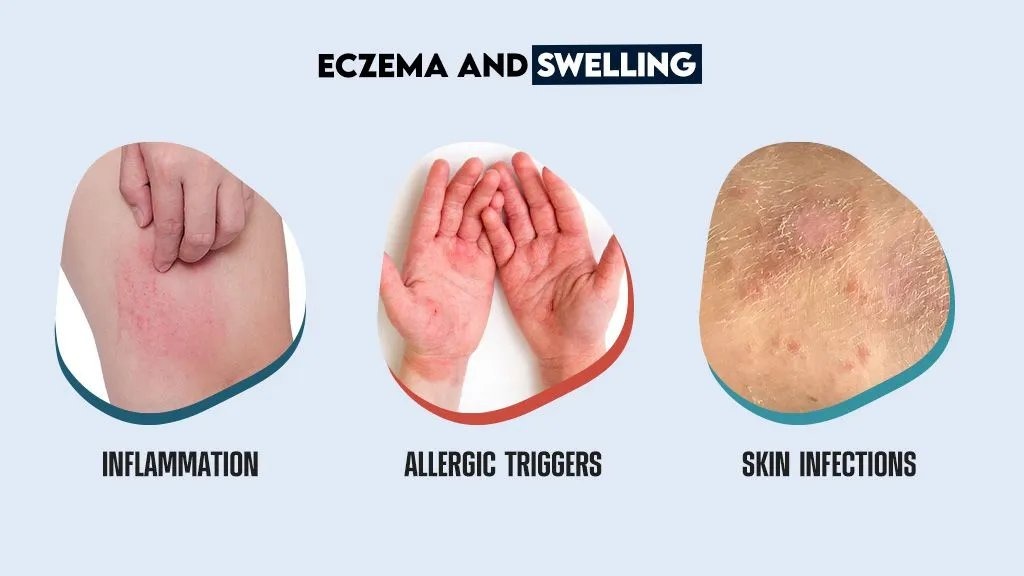
Inflamed eczema can ooze clear fluid, and fluid may dry into a crust. Weeping alone does not establish whether an infection is present. Increasing pain, warmth, pus, yellow crusting, rapid worsening or fever makes infection more concerning.
Bacteria can enter through damaged skin, and certain viral infections can spread more extensively in people with eczema. Clusters of painful blisters or small punched-out sores, especially with fever or feeling unwell, need urgent assessment for conditions such as eczema herpeticum.
Some contagious conditions resemble an eczema flare
Ringworm can cause a scaly patch, scabies can cause intense itching, and impetigo can cause crusted sores. Their treatment and precautions differ from those for eczema. Appearance alone, particularly after scratching or applying a cream, may not be enough to separate them.
A clinician may examine the distribution, ask whether others are affected and test for an infection when appropriate. Avoid repeatedly treating an uncertain rash with leftover eczema medicine without checking the diagnosis.
Use ordinary hygiene and diagnosis-specific precautions
Wash hands before applying treatments or caring for broken skin. Avoid sharing towels or personal items when an infection is suspected, and follow the clinician’s advice if one is confirmed. People with active cold sores should avoid direct contact between the sore and another person’s eczema-affected skin.
Eczema alone is not a reason to avoid ordinary affection or social contact. School, sports or work advice may differ when there is a separate infection, so base those decisions on the actual condition rather than on the word eczema.
Keep routine care separate from infection treatment
Gentle cleansing and regular moisturizer support dry skin, but they are not treatments for an infection. Use the daily eczema routine alongside the medical plan, and seek review when the symptoms change.
If a flare comes with a new lump in the neck, armpit or groin, our lymph-node guide explains why that finding should not automatically be attributed to eczema.
Reference: American Academy of Dermatology: atopic dermatitis symptoms and infection complications.

- Eczema and Swollen Lymph Nodes: Causes and When to Seek Care - March 24, 2026
- Eczema-Prone Skin and Moisture Loss: Understanding the Skin Barrier - March 24, 2026
- Eczema and the Immune System: Inflammation and Barrier Function - February 18, 2026